DSCR Loan Rates in 2026: Financing Options in the USA
Introduction
Real estate investors across the United States are looking for financing options that help them purchase rental properties, refinance existing investments, and expand their portfolios in 2026. One financing option that continues to attract attention is the Debt Service Coverage Ratio (DSCR) loan.
Unlike conventional mortgages that generally place significant emphasis on a borrower’s personal income, DSCR loans primarily evaluate whether a property’s rental income can support its mortgage payments.
For investors who own multiple properties, operate through an LLC, or earn income from self-employment, this approach can provide an alternative to traditional investment property mortgages.
But what are DSCR loan rates in 2026? Which lenders offer investor mortgages? And how can borrowers compare financing options before committing to a loan?
This guide explains how DSCR loan rates work, what affects pricing, which lender categories investors can explore, and how to evaluate rental property financing in the current U.S. market.
What Are DSCR Loan Rates in 2026?
DSCR loan rates are the interest rates charged on investment property mortgages that qualify borrowers primarily based on the rental property’s income relative to its debt obligations.
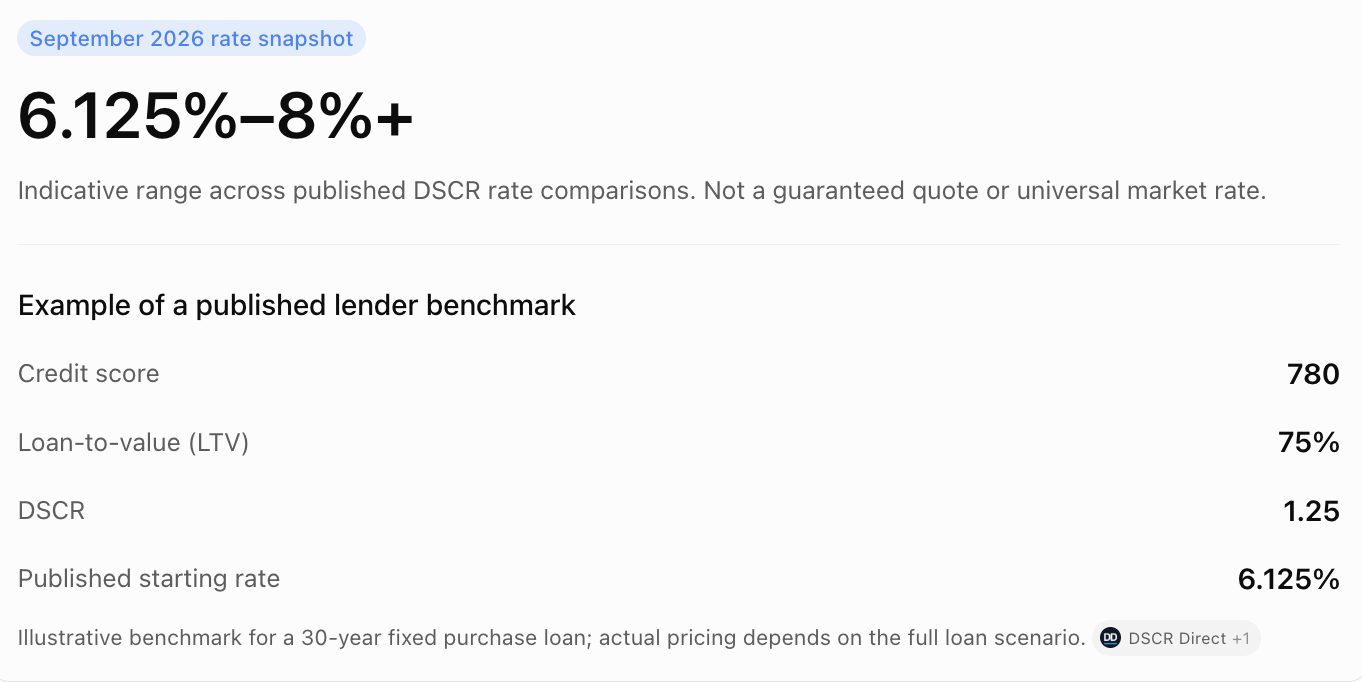
As of September 2026, published lender comparisons show DSCR mortgage rates varying considerably by credit score, down payment, property cash flow, loan structure, and lender pricing. One market comparison reports a typical range of approximately 6.25%–8.00%, while other lender data show rates outside that range for certain borrower profiles.
How Does a DSCR Loan Work?
A Debt Service Coverage Ratio loan evaluates a property’s ability to generate enough rental income to cover its debt payments.
Instead of relying primarily on personal employment income and traditional debt-to-income calculations, DSCR lenders focus on the investment property’s cash flow, alongside other underwriting requirements.
What Is the DSCR Formula?
The standard calculation is:
For many residential DSCR mortgage programs, lenders use monthly rental income divided by the monthly housing payment, often including principal, interest, property taxes, insurance, and applicable association dues. The exact calculation varies by lender and loan program.
Example: Calculating a Rental Property’s DSCR
Suppose an investor owns a rental property generating $3,000 in qualifying monthly rental income. The lender calculates the monthly housing payment at $2,400.
The property’s DSCR is 1.25, meaning its qualifying rental income is 1.25 times the monthly debt payment under this simplified calculation.
|
Monthly cash flow |
Amount |
|---|---|
|
Qualifying rental income |
$3,000 |
|
Monthly housing payment |
$2,400 |
|
Remaining before other expenses |
$600 |
|
DSCR |
1.25 |
A DSCR of 1.25 is often viewed as a useful underwriting benchmark, but lenders may accept lower ratios or require higher ones depending on the program.
A property with a DSCR below 1.0 generates less qualifying rental income than its calculated debt payment. Some lenders offer programs for such properties, potentially with different pricing, equity, or reserve requirements.

What Factors Affect DSCR Loan Rates in 2026?
Several factors influence the interest rate an investor receives. Understanding them can help borrowers compare offers more accurately.
1. Credit Score
Credit history is an important component of DSCR loan underwriting.
A higher credit score may qualify an investor for more favorable pricing, while a lower score can lead to a higher rate, stricter loan terms, or a larger down payment requirement.
Some lenders publish programs for borrowers with credit scores in the 600s, but minimum requirements vary.
2. Debt Service Coverage Ratio
The property’s rental income relative to its mortgage payment can influence lender pricing.
A property with a DSCR of 1.25 may qualify for different terms than one with a DSCR of 0.80. Some programs accept ratios below 1.0, while others set higher minimums.
Investors should confirm whether the lender calculates DSCR using market rent, an existing lease, or another income assessment method.
3. Down Payment and Loan-to-Value Ratio
The loan-to-value ratio compares the mortgage amount with the property’s appraised value or purchase price, as applicable.
For example, if a property is valued at $400,000 and the mortgage is $300,000:
A lower LTV means the borrower is contributing more equity. This can affect pricing, qualification, and the lender’s risk assessment.
4. Property Type and Location
DSCR mortgage rates can vary according to the type of property being financed.
Lenders may distinguish between:
-
Single-family rental homes
-
Condominiums
-
Two-to-four-unit residential properties
-
Short-term rental properties
-
Larger multifamily or commercial investment properties
Property condition, rental demand, insurance costs, and local market characteristics may also influence underwriting.
5. Loan Term and Structure
Investors may encounter several mortgage structures:
|
Loan type |
What to understand |
|---|---|
|
30-year fixed |
Principal and interest rate remains fixed for the term. |
|
40-year fixed |
Longer amortization can reduce scheduled payments, but may increase total interest. |
|
Adjustable-rate mortgage |
Rate may change according to the loan’s adjustment schedule. |
|
Interest-only |
Payments may initially exclude principal, followed by a different payment structure. |
|
Cash-out refinance |
Allows eligible borrowers to access some property equity, subject to underwriting. |
The lowest advertised rate may be tied to a particular loan term, prepayment penalty, or discount-point requirement. Always compare the complete terms rather than the interest rate alone.
How to Compare DSCR Loan Offers
Comparing DSCR mortgage lenders requires more than checking the interest rate displayed on a website.
An investor should request comparable quotes using the same property value, loan amount, credit profile, rental income, and repayment structure.
|
Comparison factor |
Questions to ask |
|---|---|
|
Interest rate |
Is the quote fixed or adjustable? |
|
APR |
What fees and financing costs are included? |
|
Discount points |
Is the advertised rate dependent on paying points? |
|
Down payment |
How much equity must I contribute? |
|
DSCR minimum |
What rental-income coverage does the lender require? |
|
Cash reserves |
How many months of payments must I hold? |
|
Prepayment penalty |
Is there a penalty for selling or refinancing early? |
|
Closing costs |
What appraisal, underwriting, and lender fees apply? |
|
Property eligibility |
Are short-term rentals, condos, or LLC ownership allowed? |
Why APR Matters
The interest rate represents the borrowing rate, while the annual percentage rate (APR) incorporates certain financing costs and can provide a broader basis for comparing offers.
For example, a loan advertised at a lower interest rate may require substantial upfront discount points. Another loan with a slightly higher interest rate could have lower initial costs.
Investors should compare the APR, cash required at closing, expected holding period, and prepayment provisions before choosing a mortgage.
DSCR Loans vs. Conventional Investor Mortgages
DSCR loans and conventional investment property mortgages serve different borrower situations.
|
Feature |
DSCR loan |
Conventional investor mortgage |
|---|---|---|
|
Main qualification focus |
Property rental income and overall underwriting |
Borrower income, debts, credit, and property |
|
Personal income documentation |
May be reduced or not required in the traditional form |
Generally required |
|
Multiple properties |
Some programs accommodate portfolio investors |
Subject to applicable lender and program limits |
|
LLC ownership |
Available under some programs |
Depends on loan structure and lender |
|
Interest rate |
Varies by DSCR program and borrower profile |
Depends on conventional investment property pricing |
|
Qualification |
Depends on lender’s DSCR, credit, equity, and reserve requirements |
Depends on conventional underwriting requirements |
A DSCR loan does not mean that lenders ignore the borrower’s financial background. Credit, assets, reserves, experience, and other eligibility factors may still be reviewed.
The central difference is the way qualifying income is assessed.
How Much Does a DSCR Loan Cost?
The total cost of a DSCR loan depends on the principal, interest rate, repayment term, fees, and other loan conditions.
Consider a hypothetical $300,000 mortgage with a 30-year fixed repayment schedule.

How to Qualify for a DSCR Investment Property Loan
Although requirements differ among lenders, borrowers can prepare several items before applying.
-
Identify the property. Gather the purchase price or estimated market value, property address, property type, and expected rental strategy.
-
Estimate rental income. Provide current lease information or market rent documentation acceptable to the lender.
-
Review the credit profile. Check your credit report and ask the lender about its minimum credit score and pricing adjustments.
-
Calculate the down payment. Estimate the required equity contribution and budget for closing costs.
-
Prepare financial reserves. Ask whether the lender requires a specific number of months of mortgage payments in reserve.
-
Confirm the ownership structure. If purchasing through an LLC, verify the lender’s entity requirements and any personal guarantees.
-
Compare loan estimates. Request written terms from multiple lenders and review rates, APR, fees, and prepayment provisions.
DSCR Loan Strategies for Real Estate Investors in 2026
Investors use rental property mortgages for different reasons. The financing structure should match the intended investment strategy.
Buying a Long-Term Rental Property
A DSCR loan may be considered when purchasing a single-family rental or another eligible residential investment property.
The investor evaluates the expected rental income, financing costs, property expenses, and available equity before making an offer.
Refinancing an Existing Rental Property
A rate-and-term refinance may allow an investor to replace an existing mortgage with a new loan.
Whether refinancing reduces costs depends on the new interest rate, closing expenses, remaining loan balance, and time the investor expects to hold the property.
Cash-Out Refinancing
Some DSCR lenders offer cash-out refinance options for eligible properties.
The investor may use available equity for another real estate purchase, renovations, or other business purposes. However, taking cash out increases or replaces debt and may raise monthly payments.
Expanding a Rental Portfolio
Investors with several rental properties may investigate lenders that offer portfolio-oriented financing or programs that accommodate multiple properties.
Before expanding, it is important to evaluate combined mortgage payments, vacancy exposure, maintenance costs, insurance, and the possibility of changing rental conditions.
Common DSCR Loan Mistakes to Avoid
Focusing only on the advertised rate
A low starting rate may depend on excellent credit, a low LTV, discount points, or specific loan terms.
Overestimating rental income
Market rent estimates may differ from actual achievable rent. Confirm the income figures accepted by the lender.
Ignoring prepayment penalties
A prepayment provision may affect the economics of selling or refinancing before the penalty period ends.
Underestimating operating expenses
A property can meet a lender’s DSCR requirement but still leave the investor with limited cash flow after maintenance, vacancies, and other expenses.
Assuming every property qualifies
Short-term rentals, condos, multifamily properties, and properties in certain locations may be subject to additional requirements.
Frequently Asked Questions About DSCR Loan Rates in 2026
What are DSCR loan rates in 2026?
Published September 2026 lender comparisons show many DSCR mortgage rates in the approximate 6.25%–8.00% range, with actual offers potentially falling outside that range depending on the borrower, property, and loan terms.
What credit score do I need for a DSCR loan?
Minimum credit score requirements vary by lender and loan program. Some published programs advertise minimums in the low 600s, while more favorable pricing may require a higher score. Ask lenders to confirm their current requirements for your specific loan scenario.
Can I get a DSCR loan with a DSCR below 1.0?
Some lenders offer programs that accept a DSCR below 1.0. Qualification may depend on credit score, equity, reserves, and other underwriting criteria. The interest rate and loan terms may differ from those offered for properties with stronger rental coverage.
Can I use a DSCR loan to buy a rental property through an LLC?
Some DSCR loan programs permit eligible borrowers to hold investment properties through an LLC. Requirements vary, and lenders may require personal guarantees, entity documentation, or other conditions.
Are DSCR loans available for short-term rentals?
Certain lenders offer financing for eligible short-term rental properties. They may assess rental income using specific documentation or valuation methods. Confirm whether the property location, rental model, and income calculation are permitted.
Can I refinance a DSCR loan?
Eligible borrowers may be able to refinance an existing DSCR mortgage through a rate-and-term or cash-out refinance program. Qualification depends on the lender’s current guidelines, property equity, rental income, and other conditions.
Are DSCR loans only available to experienced investors?
Not necessarily. Some programs are available to newer investors, although experience requirements vary. First-time investors should ask about minimum credit scores, down payments, reserves, and property eligibility.
How can I compare DSCR lenders in the USA?
Request written quotes from several lenders using the same property and financing assumptions. Compare the interest rate, APR, fees, down payment, DSCR requirement, reserves, prepayment penalty, and closing timeline.
Final Thoughts
DSCR loans offer real estate investors an alternative way to finance eligible rental properties by emphasizing the property’s income-generating potential.
In 2026, comparing lender offers requires a clear understanding of current pricing, credit requirements, rental-income calculations, loan structure, and the total cost of borrowing. An advertised starting rate is only one part of the decision.
Investors should review the property’s cash flow, compare written offers, and understand the full mortgage terms before committing to financing.
Explore DSCR Loan Options with Investment Property Loan Exchange
Looking to finance an investment property, refinance an existing rental, or explore options for expanding your real estate portfolio?

 Previous Post