
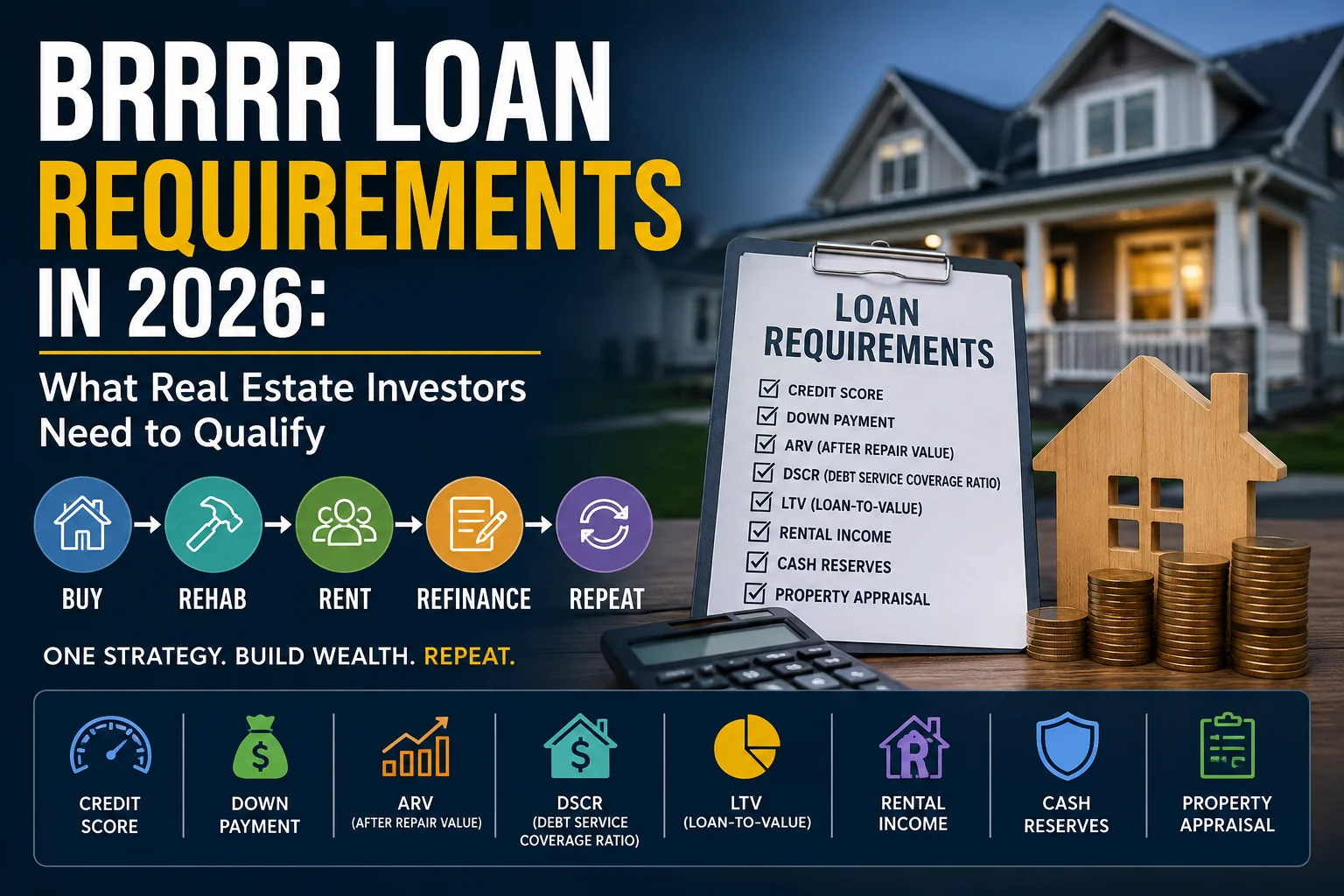
BRRRR Loan Requirements in 2026: What Real Estate Investors Need to Qualify
If you’re planning to use the BRRRR strategy in 2026, understanding the financing requirements before you purchase a property can help you avoid one of the biggest mistakes investors make: buying a property that looks profitable but cannot qualify for the refinance.
BRRRR loan requirements vary by lender and loan program, but lenders commonly evaluate the property, borrower credit, available cash, loan-to-value (LTV), rental income, debt service coverage ratio (DSCR), reserves, and the property’s after-repair value (ARV).
The most important point is that BRRRR financing is usually not one single loan. Investors often use short-term financing to purchase and renovate a property and then refinance into longer-term rental financing once the property is stabilized.
Quick Answer: What Are the Requirements for a BRRRR Loan?
Typical BRRRR financing requirements can include:
- A qualifying investment property
- Sufficient funds for the purchase, renovation, closing costs, and reserves
- Minimum credit requirements determined by the lender
- An acceptable loan-to-value ratio
- A realistic after-repair value (ARV)
- A completed or substantially completed renovation
- Rental income that supports the refinance
- An acceptable DSCR for programs that use property cash flow to qualify
- Property appraisal
- Proof of insurance
- Documentation of the purchase and renovation
- Sufficient reserves for the new loan
Requirements vary by lender, property type, loan structure, credit profile, and whether you’re using a bridge, hard-money, fix-and-flip, or DSCR loan.
What Is a BRRRR Loan?
BRRRR stands for:
Buy → Rehab → Rent → Refinance → Repeat
The strategy allows real estate investors to purchase a property that needs improvements, renovate it, place a tenant in the property, and then refinance the stabilized rental property.
The refinance can potentially return some of the investor’s original capital, which may then be used toward another investment.
For example:
A property may be purchased for $150,000 and require $40,000 in renovations. After improvements, the property could potentially appraise for $250,000.
If the property qualifies for a refinance based on the lender’s LTV and underwriting requirements, the investor may be able to recover a portion of the capital invested in the project.
However, the numbers must work before the purchase, not after the renovation.
BRRRR Loan Requirements by Stage
One of the easiest ways to understand BRRRR financing is to look at the requirements at each stage.
| BRRRR Stage | Financing Focus | Common Requirements |
| Buy | Acquisition financing | Credit, liquidity, property value, purchase contract |
| Rehab | Renovation financing | Scope of work, budget, contractor information, reserves |
| Rent | Property stabilization | Completed improvements, rental market, lease/rent documentation |
| Refinance | Long-term financing | Appraisal, ARV, rent, DSCR, LTV, credit, reserves |
| Repeat | Capital recycling | Available equity and ability to qualify for the next property |
The requirements can therefore change throughout the project.
1. Credit Score and Credit History
Your credit profile can affect your ability to qualify for BRRRR financing and may also influence your interest rate, leverage, reserve requirements, and other loan terms.
There is no universal BRRRR credit-score requirement because different lenders use different underwriting standards.
Some investment-property lenders publish minimum scores in the low-to-mid 600s, while stronger credit profiles may receive access to more favorable terms. Current 2026 lender guides show examples ranging from approximately 620 to 660+ depending on the program and borrower profile.
For investors, the key takeaway is:
Don’t focus only on the minimum credit score. A stronger credit profile can potentially improve the overall economics of the deal.
Before applying, review:
- Credit score
- Recent late payments
- Existing mortgages
- Credit utilization
- Bankruptcies or foreclosures, if applicable
- Recent credit inquiries
- Payment history
2. Down Payment and Cash Requirements
A BRRRR strategy still requires capital.
Even when a lender finances a significant portion of the purchase or renovation, you may need cash for:
- Down payment
- Closing costs
- Renovation expenses not covered by financing
- Loan fees
- Interest payments
- Property taxes
- Insurance
- Utilities
- Carrying costs
- Emergency repairs
- Cash reserves
The exact amount depends on the financing structure.
For example, a short-term acquisition loan may have different leverage requirements from the DSCR loan you intend to use during the refinance.
This is why BRRRR investors should calculate their total cash requirement, rather than looking only at the down payment.
3. Loan-to-Value (LTV) Requirements
LTV is one of the most important numbers in a BRRRR transaction.
The basic formula is:
LTV = Loan Amount ÷ Property Value × 100
Suppose a property is worth $250,000 and the refinance loan is $187,500.
The LTV would be:
$187,500 ÷ $250,000 = 75% LTV
The maximum LTV available to you will depend on the lender, property type, loan purpose, credit profile, occupancy, and other underwriting factors.
For a BRRRR investor, LTV matters because it directly affects how much capital can potentially be recovered during the refinance.
4. After-Repair Value (ARV)
ARV stands for After-Repair Value.
It represents the estimated market value of the property after the planned renovations have been completed.
ARV is critical to BRRRR financing because the value created through renovation can determine how much equity is available for the refinance.
Example
Suppose:
Purchase price: $150,000
Renovation: $40,000
Other costs: $10,000
Total investment:
$200,000
After the renovation, the property appraises at:
$275,000
That creates approximately:
$75,000 of gross equity
before considering financing costs and other transaction expenses.
However, investors should never assume that the property will automatically appraise at their projected ARV.
A professional appraisal and the lender’s valuation methodology ultimately determine the value used for underwriting.
5. Property Requirements
The property itself is another major part of BRRRR qualification.
Depending on the loan program, lenders may evaluate:
- Property type
- Location
- Condition
- Number of units
- Marketability
- Rental potential
- Comparable properties
- Appraised value
- Insurance availability
- Title
- Existing liens
- Zoning
- Occupancy
Single-family rental properties and small multifamily properties are commonly used for BRRRR strategies, but eligible property types vary by lender.
Before purchasing, confirm that your intended lender will finance the exact property you are considering.
6. Rental Income Requirements
The “Rent” portion of BRRRR becomes especially important when you reach the refinance stage.
For many investor-focused rental programs, the property’s rental income plays an important role in determining whether the property can support the new debt.
This is where DSCR becomes important.
DSCR stands for Debt Service Coverage Ratio.
A simplified formula is:
DSCR = Qualifying Rental Income ÷ Monthly Debt Obligations
For example, if qualifying monthly rental income is $3,000 and the lender’s calculated monthly debt obligation is $2,500:
DSCR = 3,000 ÷ 2,500 = 1.20
A DSCR above 1.00 means the property’s qualifying income exceeds the calculated debt obligation.
However, lenders use different underwriting formulas and may have different minimum DSCR requirements. Some current 2026 lender programs publish minimums around 1.00x, while others require higher ratios or offer different terms at lower ratios.
7. Appraisal Requirements
The refinance generally requires a valuation of the property.
For a BRRRR investor, the appraisal can make or break the refinance strategy.
Suppose you expected:
ARV: $300,000
But the appraisal comes in at:
$260,000
The maximum refinance amount may be significantly lower than your original calculation.
This can leave more of your capital trapped in the property.
That’s why investors should conduct conservative ARV analysis before purchasing.
Look at:
- Recent comparable sales
- Property size
- Location
- Bedroom and bathroom count
- Renovation quality
- Comparable renovated properties
- Local rental demand
- Market conditions
8. Debt Service Coverage Ratio Requirements
If you’re using a DSCR loan as the permanent financing portion of your BRRRR strategy, the property generally needs enough qualifying rental income to support the proposed debt.
For example:
Monthly rent: $2,800
Calculated monthly debt obligation: $2,400
DSCR:
$2,800 ÷ $2,400 = 1.17
A lender may approve the property under a program accepting that ratio, while another lender may require a higher ratio.
This is why investors should compare loan programs instead of assuming that every DSCR lender uses the same requirements.
9. Cash Reserves
Having enough money to close isn’t necessarily enough.
Many investment-property loan programs require borrowers to maintain reserves after closing.
Reserves can help cover:
- Mortgage payments
- Taxes
- Insurance
- Unexpected repairs
- Vacancy
- Maintenance
- Other property expenses
Current lender guides commonly describe reserve requirements in terms of several months of housing payments, but the exact amount varies by program and borrower profile.
For BRRRR investors, maintaining liquidity is particularly important because construction delays, appraisal issues, vacancy, and refinance delays can increase holding costs.
10. Renovation Documentation
If you’re using financing to purchase and renovate the property, the lender may want information about the renovation.
Depending on the program, this can include:
- Scope of work
- Contractor information
- Renovation budget
- Invoices
- Estimates
- Draw schedule
- Property inspection
- Before-and-after documentation
Keep detailed records throughout the renovation.
Good documentation can also make it easier to explain the improvements and costs associated with the project.
11. Documentation You May Need
BRRRR financing documentation varies by loan type.
Depending on the lender, you may be asked for:
- Government-issued identification
- Credit authorization
- Purchase contract
- Bank statements
- Proof of funds
- Entity documents
- Property insurance
- Lease agreement
- Rent documentation
- Appraisal
- Property information
- Renovation budget
- Contractor information
- Existing mortgage information
- Closing documents
One important distinction is that DSCR loans are often underwritten differently from conventional owner-occupied mortgages. Some DSCR programs emphasize property cash flow rather than traditional personal-income documentation, but that does not mean the borrower has no documentation requirements.
12. BRRRR Loan Requirements: Hard Money vs. DSCR
The financing requirements can look very different depending on the stage of the BRRRR strategy.
| Requirement | Hard Money / Bridge | DSCR Refinance |
| Primary purpose | Purchase/rehab | Long-term rental financing |
| Property value | Important | Important |
| ARV | Often important | Important for refinance |
| Credit | Considered | Considered |
| Rental income | Usually less important initially | Very important |
| DSCR | Usually not the primary metric | Often a major metric |
| Renovation scope | Important | Usually property should be stabilized |
| Appraisal | Common | Common |
| Reserves | Often required | Often required |
| Exit strategy | Very important | Less relevant after stabilization |
The exact requirements depend on the lender and program.
13. Can You Get a BRRRR Loan With Bad Credit?
Possibly, but your options may become more limited.
Investors with weaker credit may encounter:
- Higher interest rates
- Lower maximum LTV
- Larger equity requirements
- Additional reserves
- More restrictive property requirements
- Fewer available lenders
Rather than asking only whether you can qualify, evaluate whether the financing still allows the BRRRR deal to produce an acceptable return.
A loan that technically qualifies may still make the project financially unattractive.
14. Can You Use a DSCR Loan for a BRRRR Refinance?
Yes.
A DSCR loan can be used as the long-term financing portion of a BRRRR strategy when the property and borrower meet the lender’s requirements.
The basic process looks like this:
Buy → Renovate → Rent → Appraise → DSCR Refinance → Recover Capital → Repeat
The DSCR refinance is particularly relevant because the lender evaluates the property’s ability to support the debt rather than relying exclusively on traditional personal-income underwriting.
However, DSCR programs differ in their treatment of seasoning, cash-out refinances, LTV, credit, reserves, rental income, and property types. Investors should confirm the exact guidelines before relying on a refinance strategy.
15. How to Calculate Whether a BRRRR Deal Can Work
Before buying a property, calculate your total project cost.
Example
Purchase: $160,000
Renovation: $35,000
Closing costs: $8,000
Holding costs: $7,000
Total project cost: $210,000
Estimated ARV:
$280,000
Potential refinance at a hypothetical 75% LTV:
$280,000 × 75% = $210,000
In this simplified example, the potential refinance amount equals the estimated project cost.
But this does not mean the investor is guaranteed to recover $210,000.
The actual result depends on:
- Final appraisal
- Lender’s LTV limit
- Loan costs
- Cash-out rules
- Seasoning requirements
- DSCR
- Credit profile
- Property eligibility
- Closing costs
- Other lender-specific requirements
This is why BRRRR investors should calculate the refinance before committing to the purchase.
16. Common BRRRR Financing Mistakes
Mistake 1: Assuming the ARV will be higher than the appraisal
Always use conservative comparable sales.
Mistake 2: Forgetting holding costs
Renovations often take longer than expected.
Mistake 3: Ignoring the refinance requirements
The acquisition loan may be easy to obtain, but the permanent refinance is what ultimately determines whether you can recycle your capital.
Mistake 4: Using every dollar available for the purchase
Keep reserves for unexpected expenses.
Mistake 5: Assuming every DSCR lender has the same guidelines
They don’t.
Mistake 6: Focusing only on the interest rate
Loan-to-value, fees, reserves, prepayment penalties, seasoning requirements, DSCR requirements, and closing costs can all affect the economics of the deal.
17. BRRRR Loan Requirements Checklist
Before applying for BRRRR financing, review:
-
Investment property identified
-
Purchase price confirmed
-
Renovation budget prepared
-
Conservative ARV estimated
-
Comparable sales reviewed
-
Expected rent researched
-
DSCR estimated
-
LTV calculated
-
Total project cost calculated
-
Available cash confirmed
-
Reserves calculated
-
Credit profile reviewed
-
Acquisition lender identified
-
Refinance lender/program identified
-
Seasoning requirements confirmed
-
Property eligibility confirmed
-
Exit strategy documented
Frequently Asked Questions About BRRRR Loan Requirements
What credit score do I need for a BRRRR loan?
There is no universal minimum credit score. Requirements vary by lender and loan program. Some investment-property programs publish minimums around 620–660, while stronger credit can provide access to better terms.
How much money do I need for a BRRRR loan?
Your required cash depends on the purchase price, financing structure, renovation costs, closing costs, reserves, and lender leverage. You should calculate the entire project budget rather than assuming the down payment is your only cash requirement.
Do BRRRR loans require tax returns?
It depends on the loan product. Some DSCR investment-property programs focus on the property’s rental income rather than traditional personal-income documentation. Other financing products may require more conventional documentation.
What is the minimum DSCR for a BRRRR loan?
There is no universal minimum. Some current DSCR programs accept ratios around 1.00x, while others require higher ratios or adjust leverage and pricing based on the DSCR.
Can I refinance a BRRRR property with a DSCR loan?
Yes. DSCR financing can be used for the refinance stage of a BRRRR strategy when the property and borrower meet the lender’s guidelines.
How long do I have to wait before refinancing?
The required seasoning period varies by lender and program. Some investment-property programs publish specific seasoning periods, while others may offer different treatment depending on the transaction and documentation. Confirm the requirement with the lender before purchasing the property.
Can I use an LLC for a BRRRR loan?
Some investment-property lenders allow borrowers to hold properties in an LLC or other business entity, but entity requirements vary. Confirm the lender’s vesting and guarantor requirements before closing.
What happens if the property appraises for less than expected?
A lower appraisal can reduce the amount you can refinance and may leave more of your original capital invested in the property. This is why conservative ARV analysis is one of the most important parts of BRRRR deal planning.
Final Thoughts
The best BRRRR deals are not created by simply finding a property that needs renovations. They are created by understanding the entire financing cycle before purchasing the property.
You need to know how you will fund the acquisition, how much the renovation will cost, what the property could realistically be worth after improvements, what rent it can generate, and whether the property will qualify for the intended refinance.
The most important BRRRR loan requirements to evaluate are therefore:
Credit → Capital → Property → ARV → Rent → DSCR → LTV → Reserves → Refinance
If those numbers work together, the BRRRR strategy can potentially allow investors to recycle capital into additional rental properties.
For a broader explanation of the entire strategy, see our BRRRR Loan Guide, which covers the Buy, Rehab, Rent, Refinance, and Repeat process in greater detail.
Loan requirements, underwriting standards, rates, fees, LTV limits, DSCR thresholds, seasoning rules, and property eligibility vary by lender and can change over time. This article is for educational purposes and is not a commitment to lend or financial advice.
 Previous Post
 Next Post


