
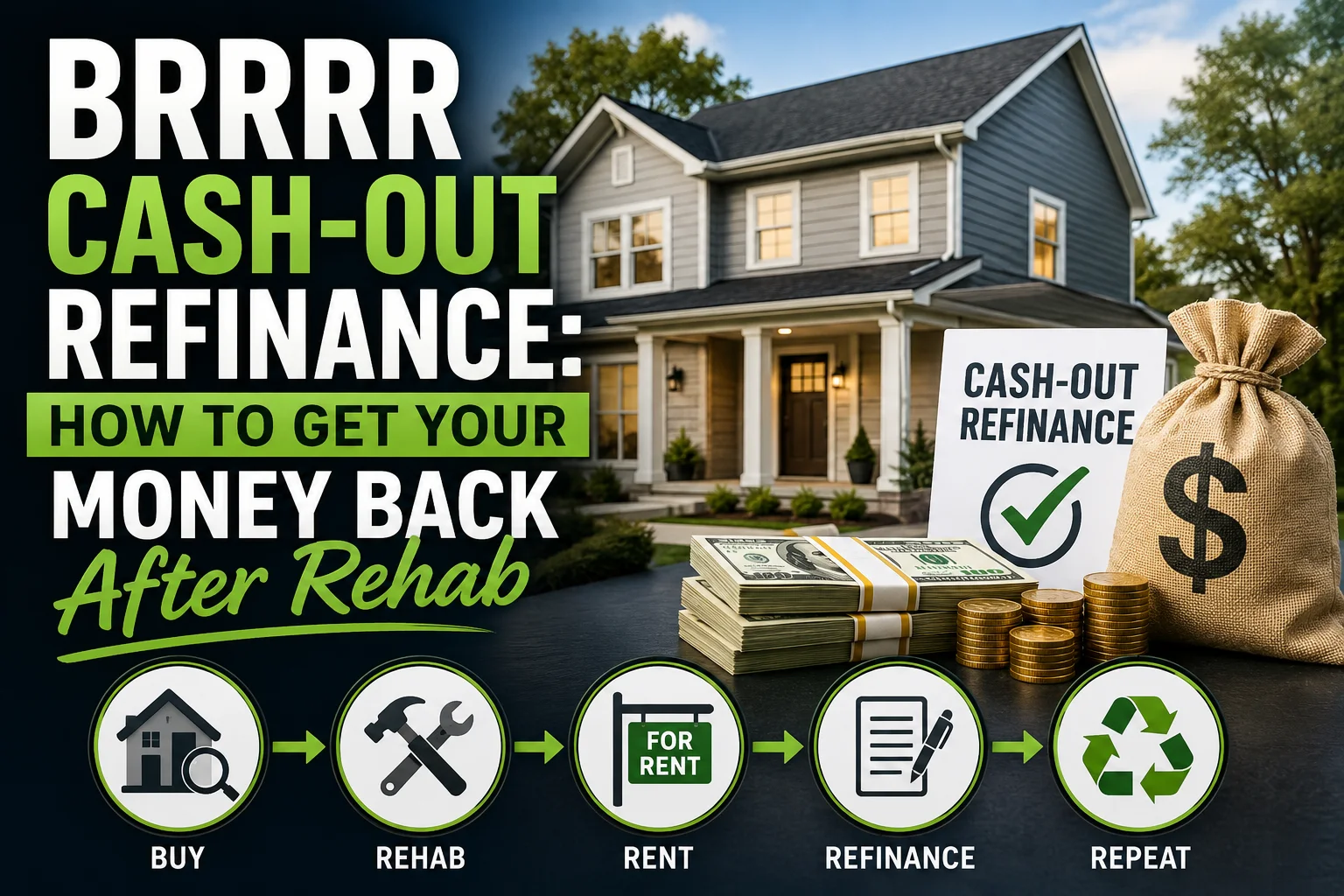
BRRRR Cash-Out Refinance: How to Get Your Money Back After Rehab
If you are using the BRRRR strategy to build a rental property portfolio, the refinance stage is where the strategy is designed to become repeatable.
You buy an undervalued property, complete the necessary renovations, rent it to a tenant, and then refinance the property based on its improved value. The goal is to recover as much of your invested capital as the loan structure and property value allow, so that you can use that capital toward another investment.
This is why the refinance is such an important part of BRRRR investing.
A property can look like a great BRRRR opportunity when you buy it, but if the numbers do not support the eventual refinance, your capital can remain tied up in the property.
In this guide, we explain how a BRRRR cash-out refinance works, what lenders typically evaluate, how DSCR financing fits into the strategy, what can reduce the amount of cash you receive, and how to prepare for the refinance before you even purchase the property.
Planning a BRRRR investment? Start with our complete BRRRR loan guide to understand how acquisition, rehab, rental and refinance financing work together.
What Is a BRRRR Cash-Out Refinance?
A BRRRR cash-out refinance is the process of replacing the short-term financing used to purchase and renovate an investment property with longer-term financing after the property has been improved and stabilized.
The refinance can potentially allow an investor to access some of the equity created through the renovation and property appreciation.
The basic sequence looks like this:
Buy → Rehab → Rent → Refinance → Repeat
During the purchase and renovation stages, investors commonly use short-term financing such as bridge or hard money loans. Once the property is renovated and ready to operate as a rental, the investor can pursue longer-term financing, often through a DSCR loan.
The objective is not simply to replace one loan with another.
The objective is to structure the transaction so that the property can support the new loan while allowing the investor to recover a meaningful portion of the capital invested in the project.
How Does the BRRRR Refinance Work?
The refinance stage generally follows several steps.
1. Complete the Renovation
The property needs to reach the condition required for the intended rental and refinance program.
That means completing the planned improvements, addressing material property issues and making sure the finished property is ready for appraisal and occupancy.
Keeping records throughout the renovation can also be important.
Maintain:
- Contractor invoices
- Receipts
- Draw documentation
- Before-and-after photographs
- Permits when applicable
- Scope-of-work documentation
- Property improvement records
Good documentation helps demonstrate what was done to the property and how the renovation budget was used.
2. Stabilize the Rental Property
After the renovation, the property needs to function as an income-producing investment.
Depending on the loan program, the lender may consider factors such as:
- Rental income
- Market rent
- Lease information
- Property condition
- Operating expenses
- Property taxes
- Insurance
- HOA expenses, when applicable
This is especially important when the refinance uses DSCR underwriting.
3. Obtain an Appraisal
The lender will generally need to establish the property’s current value.
This is one of the most important points in a BRRRR transaction.
Your refinance proceeds are not determined simply by how much money you spent on the property.
The lender is concerned with the property’s value, the applicable loan-to-value requirements, the property’s income and the specific refinance program.
For example, spending $75,000 on a renovation does not automatically mean the property value increases by $75,000.
The completed property’s market value has to support the refinance.
4. Determine the Refinance Amount
Once the property value and other underwriting factors are established, the lender determines how much can be borrowed under the selected program.
The maximum loan amount may be influenced by:
- Appraised value
- Loan-to-value requirements
- Property type
- Rental income
- DSCR
- Credit profile
- Existing liens
- Reserves
- Loan program requirements
The investor then compares the available refinance proceeds with the amount invested in the project.
5. Pay Off the Short-Term Loan
The new long-term loan is used to pay off the original bridge or hard money financing.
This removes the short-term debt that was used to acquire and renovate the property.
If the new loan amount is greater than the payoff and transaction costs, the remaining eligible proceeds may be available to the investor as cash-out proceeds.
6. Reinvest the Recovered Capital
This is where the “Repeat” in BRRRR becomes possible.
Instead of leaving all of your investment capital tied up in the first property, you may be able to redeploy some of the recovered capital into another acquisition.
The process can then begin again:
Acquire → Renovate → Rent → Refinance → Reinvest
The strategy becomes increasingly dependent on buying correctly, controlling renovation costs and accurately estimating the property’s post-rehab value.
Why DSCR Loans Are Important to the BRRRR Strategy
Debt-Service Coverage Ratio, or DSCR, financing can be particularly useful during the refinance stage because the property’s income is a major part of the underwriting process.
Instead of relying primarily on the borrower’s personal employment income, a DSCR loan evaluates whether the investment property’s income can support its debt obligations.
A simplified DSCR calculation is:
DSCR = Property Income ÷ Debt Obligations
For example, if a rental property’s qualifying monthly income is $2,500 and its applicable monthly debt obligations are $2,000:
$2,500 ÷ $2,000 = 1.25 DSCR
The exact underwriting methodology and qualifying income can vary by lender and program.
For BRRRR investors, this can make DSCR financing particularly attractive when the property itself has strong rental economics.
However, investors should not assume that every property will qualify simply because it generates rent.
The refinance still depends on the complete loan structure, property characteristics and lender requirements.
How Much Cash Can You Get From a BRRRR Refinance?
There is no universal amount.
The amount of cash you can potentially recover depends on the property’s appraised value, the maximum loan-to-value permitted by the program, the existing loan payoff, closing costs and other underwriting considerations.
A simplified example can help illustrate the concept.
Imagine you:
- Purchase a property for $150,000
- Invest $50,000 in renovations
- Have total project costs of $200,000
- The completed property appraises at $300,000
The refinance calculation does not simply ask whether you spent $200,000.
The lender considers how much debt can be supported against the property’s qualifying value under the selected refinance program.
If the resulting refinance loan is sufficient to pay off the short-term financing and return a substantial portion of your original investment, you may be able to redeploy that capital into another property.
This is why ARV and refinance assumptions should be calculated before purchasing the property.
What Is ARV in a BRRRR Refinance?
ARV stands for After Repair Value.
It is the estimated market value of the property after the planned renovations have been completed.
ARV is one of the most important numbers in a BRRRR deal because the entire strategy depends on creating enough value between the acquisition cost, renovation investment and completed property value.
A simple example:
Purchase Price: $140,000
Rehab: $40,000
Total Acquisition + Rehab: $180,000
Estimated ARV: $260,000
The difference between the total project cost and the estimated completed value represents the potential equity created through the project.
But an estimated ARV is not the same thing as a guaranteed appraisal.
That distinction is critical.
What Happens If the BRRRR Property Appraises Low?
A low appraisal can significantly change the economics of a BRRRR deal.
Suppose you expected the property to appraise at $300,000 but the final appraisal comes in at $260,000.
The lender’s maximum refinance amount may then be lower than you expected.
That can leave more of your original capital trapped in the property.
Possible reasons for a lower-than-expected appraisal include:
- Weak comparable sales
- Overestimating the property’s post-renovation value
- Renovations that do not add as much market value as expected
- Location limitations
- Market conditions
- Property-specific issues
- Differences between the finished property and comparable properties
This is why experienced BRRRR investors generally work backward from conservative numbers rather than relying on the most optimistic ARV estimate.
How Long Do You Have to Wait Before Refinancing?
The required holding or seasoning period depends on the lender and refinance program.
Some BRRRR-focused programs may allow refinancing after a relatively short seasoning period, while other lenders may require a longer ownership period.
The current Investment Property Loan Exchange BRRRR program page states that its seasoning requirement can be as short as three months, while the broader market can vary by program.
Investors should confirm the applicable seasoning requirement before closing the acquisition loan.
A good question to ask your lender is:
“If I buy this property using your short-term financing, exactly when will I be eligible for the planned refinance?”
Getting that answer before purchasing can help prevent an unexpected financing gap.
What Can Prevent a Successful BRRRR Refinance?
Several issues can cause problems at the refinance stage.
1. The Property Does Not Appraise High Enough
If the completed property’s value is lower than expected, the available refinance proceeds may also be lower.
2. The Rental Income Is Too Low
A property may have a strong ARV but weak rental economics.
If the rental income does not adequately support the proposed debt, the refinance may not work as expected.
3. The Rehab Budget Was Too High
Overspending on renovations reduces the potential spread between total investment and completed property value.
Not every renovation produces the same amount of value.
4. The Investor Underestimated Closing Costs
Acquisition costs, financing fees, carrying costs, refinance costs and other expenses can materially affect the amount of capital that needs to be recovered.
5. The Investor Did Not Plan the Exit Financing
One of the biggest BRRRR mistakes is waiting until the renovation is finished to think about refinancing.
The refinance should be part of the original acquisition strategy.
How to Calculate Your BRRRR Numbers Before You Buy
Before making an offer, build a complete project model.
At minimum, estimate:
Acquisition Costs
- Purchase price
- Closing costs
- Initial repairs
- Financing fees
Renovation Costs
- Contractor costs
- Materials
- Permits
- Contingency
- Holding costs
Rental Economics
- Expected monthly rent
- Property taxes
- Insurance
- HOA
- Maintenance
- Vacancy assumptions
- Property management
Refinance Assumptions
- Conservative ARV
- Expected loan-to-value
- Existing loan payoff
- Refinance closing costs
- Expected monthly debt service
- DSCR
The goal is to determine whether the deal still works when your assumptions are conservative.
If the deal only works when everything goes perfectly, it may not be a strong BRRRR deal.
BRRRR Refinance Example
Consider this simplified scenario.
An investor purchases a distressed rental property for $160,000.
The investor spends $45,000 on renovations.
The total purchase and renovation investment is therefore:
$205,000
After the renovation, the property is rented and the investor obtains an appraisal.
The completed value is determined to be $285,000.
The investor then approaches a long-term rental lender for a refinance.
The lender evaluates:
- Property value
- Rental income
- DSCR
- Loan-to-value
- Credit
- Reserves
- Existing debt
- Property type
- Loan program requirements
If the approved refinance amount is sufficient to pay off the original financing and return a substantial amount of the investor’s invested capital, that money can potentially be redeployed into another investment.
The exact cash-out amount depends on the final loan approval and transaction costs.
The important lesson is that the refinance needs to be modeled before the purchase, not after the renovation.
BRRRR Refinance vs. Traditional Cash-Out Refinance
A BRRRR refinance is often discussed as a cash-out refinance, but the investment strategy behind it is different from a typical homeowner cash-out transaction.
With a conventional investment-property strategy, an investor may purchase a stabilized rental and hold it for years before deciding to access equity.
With BRRRR, the investor intentionally creates value through acquisition and renovation and then plans the refinance as part of the original investment strategy.
The refinance is therefore not an afterthought.
It is one of the five steps.
How to Prepare for a BRRRR Refinance
Start preparing for the refinance before the rehab is finished.
Keep Your Documentation Organized
Maintain invoices, receipts, contracts and renovation records.
Track Your Actual Project Costs
Do not rely on your original budget.
Know exactly how much capital has gone into the property.
Monitor Comparable Properties
Keep an eye on recently sold properties that are similar to your completed rental.
Confirm Expected Rental Income
Make sure your expected rent is realistic and supported by market data.
Understand Your Exit Loan
Know the likely refinance program, requirements and timeline before you start the project.
Maintain Adequate Reserves
A renovation can take longer or cost more than expected.
Having reserves can prevent a temporary setback from becoming a financing emergency.
Is BRRRR Cash-Out Refinancing Right for Every Investor?
No.
BRRRR works best when the investor can identify a property with a realistic value-creation opportunity and structure the financing around the entire investment cycle.
It may be less attractive when:
- The acquisition price is too close to market value
- Renovation costs are difficult to estimate
- The expected ARV is highly speculative
- Rental income is insufficient
- The refinance assumptions are too aggressive
- The investor does not have adequate reserves
- The property has characteristics that limit financing options
The strategy is not simply about buying a cheap property.
It is about creating a financially viable path from acquisition to long-term rental financing.
BRRRR Cash-Out Refinance FAQs
Can I refinance a BRRRR property after completing the rehab?
Potentially, yes. The timing depends on the lender and refinance program, including any applicable seasoning requirements.
Do I need a DSCR loan for a BRRRR refinance?
Not necessarily, but DSCR loans are commonly used for the long-term rental financing stage because qualification can focus heavily on the property’s cash flow rather than traditional personal-income documentation.
Does the appraisal determine how much cash I can get back?
The appraisal is an important factor because the property’s value influences the maximum loan amount available under the applicable loan-to-value requirements. It is not the only factor.
What happens if my BRRRR appraisal is lower than expected?
A lower appraisal can reduce the maximum refinance amount and leave more of your original investment in the property.
Should I arrange the refinance before buying the property?
It is generally wise to understand your expected exit financing before purchasing. The refinance assumptions are an important part of determining whether the initial deal makes sense.
Can I use the refinance proceeds to buy another investment property?
Subject to the loan terms, closing costs, underwriting and applicable requirements, investors may use available cash-out proceeds for future investment purposes.
How does DSCR help BRRRR investors?
DSCR financing evaluates the property’s ability to support its debt obligations through its income. This can be useful for investors whose personal income documentation does not fit traditional underwriting models.
Final Thoughts: Plan the Refinance Before You Buy
The biggest mistake a BRRRR investor can make is treating the refinance as the final step rather than planning it from the beginning.
A successful BRRRR deal starts with the exit strategy.
Before you purchase, estimate the property’s conservative ARV, renovation costs, expected rent, financing costs and potential refinance amount.
Then ask one simple question:
Will the numbers still work if the appraisal comes in lower, the rehab costs more and the refinance takes longer than expected?
If the answer is yes, you may have a much stronger BRRRR opportunity.
If you are looking for financing for a property you plan to buy, renovate, rent and refinance, explore the complete BRRRR loan guide or speak with the Investment Property Loan Exchange team about your financing options.
Ready to Plan Your BRRRR Deal?
Don’t wait until the rehab is finished to think about the refinance.
Get your acquisition and refinance strategy aligned before you commit to the property.
 Previous Post


