Commercial DSCR Loan Rates: What Investors Need to Know in 2026
If you’re researching commercial DSCR loan rates, you’re likely an investor trying to answer one core question:
“How expensive is DSCR financing right now — and is it worth it for my deal?”
DSCR (Debt Service Coverage Ratio) loans have become one of the most popular financing options for real estate investors because they focus on property cash flow, not personal income. But DSCR loan rates can vary widely depending on the deal structure, market conditions, and risk profile.
This guide breaks everything down clearly — rates, factors, examples, and how to secure the best DSCR loan terms.
Table of Contents
- What Is a Commercial DSCR Loan?
- Current Commercial DSCR Loan Rates
- What Affects Commercial DSCR Loan Rates?
- DSCR Loan Rate Examples
- DSCR Loans vs Traditional Commercial Loans
- How to Get the Best Commercial DSCR Loan Rate
- FAQs About Commercial DSCR Loan Rates
What Is a Commercial DSCR Loan?
A commercial DSCR loan is a real estate loan where qualification is based primarily on the Debt Service Coverage Ratio (DSCR) of the property rather than the borrower’s personal income, tax returns, or employment history.
DSCR is calculated as:
DSCR = Net Operating Income ÷ Annual Debt Service
- DSCR 1.00 means the property breaks even
- DSCR 1.20+ indicates healthy cash flow
- DSCR below 1.00 indicates negative cash flow
Most lenders require a minimum DSCR between 1.00 and 1.25, depending on loan size, property type, and risk tolerance.

Current Commercial DSCR Loan Rates
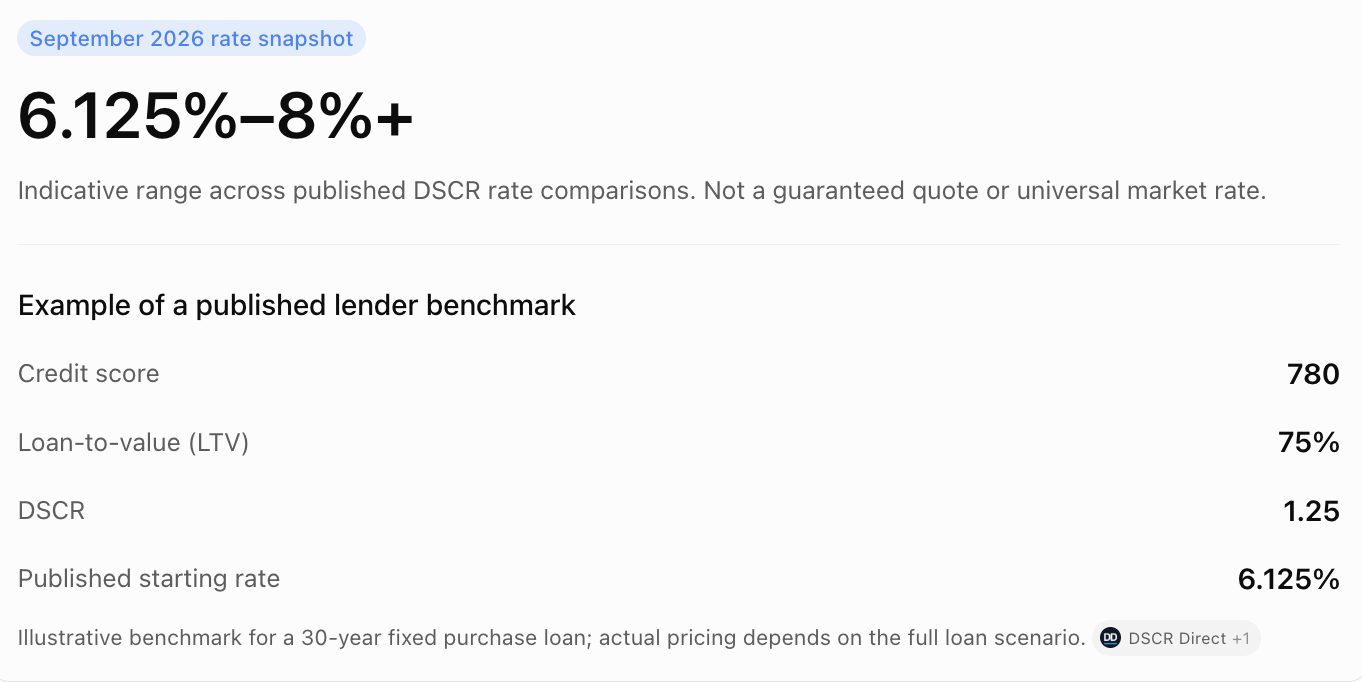
As of 2026, commercial DSCR loan rates typically range between 7.25% and 10.75%, depending on deal strength.
Typical DSCR Rate Ranges
| Property & Risk Profile | Estimated Rate Range |
|---|---|
| Strong DSCR (1.30+) | 7.25% – 8.25% |
| Average DSCR (1.10–1.25) | 8.25% – 9.50% |
| Low DSCR (1.00–1.10) | 9.50% – 10.75% |
| Short-Term / Bridge DSCR | 10.00% – 12.00% |
DSCR loan rates are generally higher than owner-occupied commercial loans because they are considered investment-grade lending.
What Affects Commercial DSCR Loan Rates?
Several factors influence where your rate will fall within the range.
DSCR Ratio
Higher DSCR ratios indicate lower risk and result in better pricing. Properties barely meeting the minimum DSCR threshold will receive higher rates.
Loan-to-Value (LTV)
- 65%–70% LTV offers the best pricing
- 75%–80% LTV increases interest rates
Property Type
- Multifamily properties usually receive lower rates
- Mixed-use properties fall in the middle
- Retail, hospitality, or specialty assets often carry higher rates
Loan Structure
Interest-only periods, short-term loans, or flexible prepayment options can increase rates.
Market Location
Primary and secondary metropolitan markets generally receive better pricing than tertiary or rural locations.
DSCR Loan Rate Examples
Example 1: Strong Cash-Flowing Multifamily
- Purchase Price: $2,000,000
- Net Operating Income: $180,000
- Annual Debt Service: $135,000
- DSCR: 1.33
- Estimated Rate: 7.50%
Example 2: Mixed-Use Property
- Purchase Price: $1,250,000
- Net Operating Income: $105,000
- Annual Debt Service: $95,000
- DSCR: 1.10
- Estimated Rate: 9.25%
Example 3: Low DSCR Commercial Property
- Purchase Price: $900,000
- Net Operating Income: $78,000
- Annual Debt Service: $77,000
- DSCR: 1.01
- Estimated Rate: 10.50%
DSCR Loans vs Traditional Commercial Loans
| Feature | DSCR Loan | Traditional Commercial Loan |
|---|---|---|
| Income Verification | Property income only | Personal & business income |
| Tax Returns | Not required | Required |
| Approval Speed | Faster | Slower |
| Interest Rates | Higher | Lower |
| Scalability | High | Limited |
DSCR loans trade slightly higher rates for speed, flexibility, and scalability, making them ideal for portfolio investors.
How to Get the Best Commercial DSCR Loan Rate
To secure the most competitive DSCR loan rate:
- Increase property NOI before applying
- Reduce LTV with a larger down payment
- Choose stabilized asset classes
- Avoid interest-only terms when possible
- Work with lenders that compare multiple DSCR programs
Even a 0.10 improvement in DSCR can reduce rates by 50–100 basis points, significantly impacting long-term returns.

FAQs About Commercial DSCR Loan Rates
What is a good commercial DSCR loan rate?
A strong deal typically qualifies for rates between 7.25% and 8.50%, depending on market conditions.
Are DSCR loan rates fixed or adjustable?
Most DSCR loans offer fixed-rate options, though adjustable and bridge products are available.
Do DSCR loans require personal income verification?
No. Qualification is based on property cash flow, not borrower income.
Can first-time investors get DSCR loans?
Yes. Many DSCR programs allow first-time investors with strong properties.
Are DSCR loans higher than conventional loans?
Yes, but they provide faster approvals and fewer documentation requirements.
Final Thoughts
Commercial DSCR loan rates reflect a balance between flexibility and risk. While rates are higher than traditional commercial loans, DSCR financing allows investors to scale more efficiently by leveraging property income rather than personal financials.
Comparing structures, DSCR thresholds, and long-term cash flow impact is more important than focusing on rate alone.
 Previous Post
 Next Post