
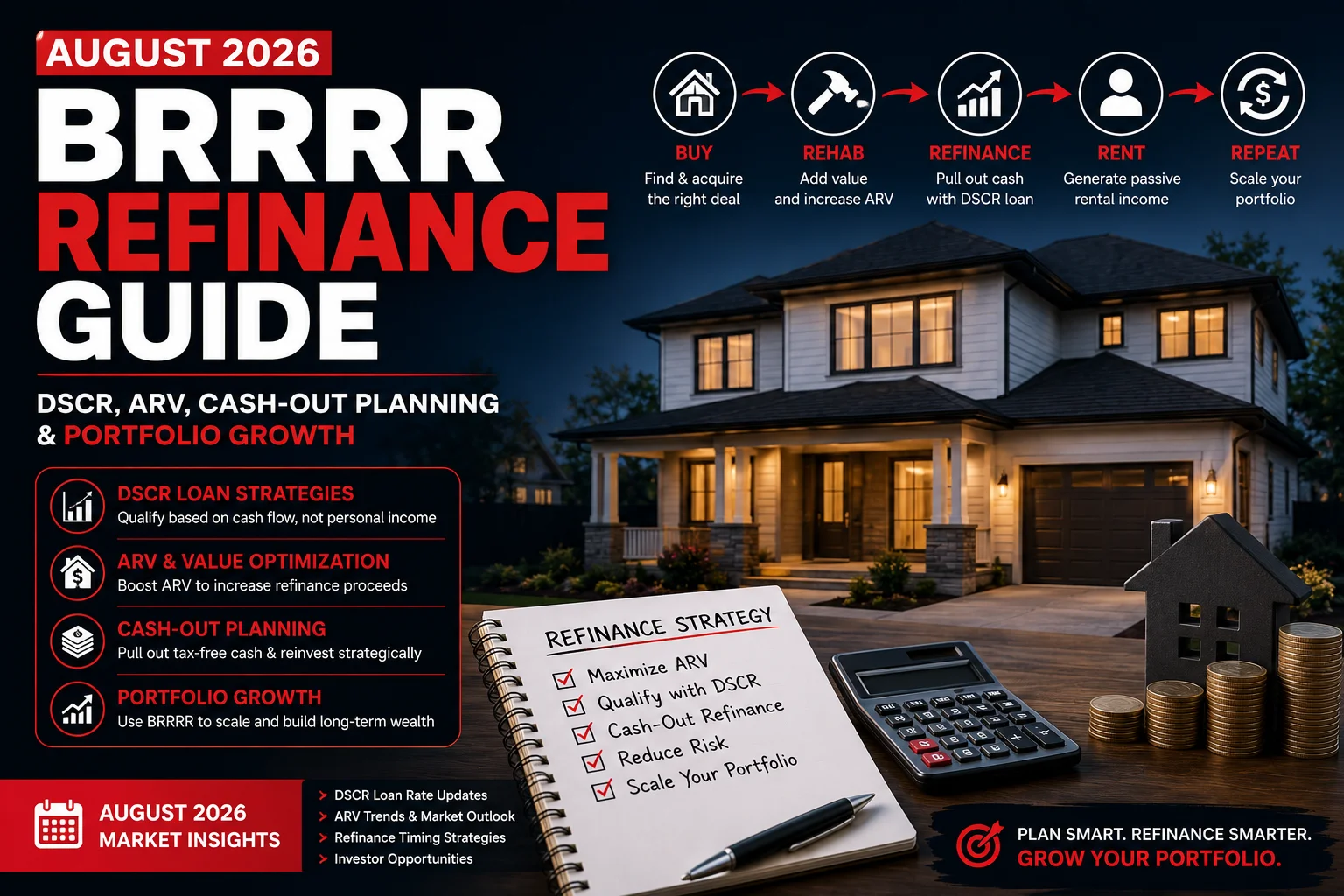
August 2026 BRRRR Refinance Guide: DSCR, ARV, Cash-Out Planning & Portfolio Growth
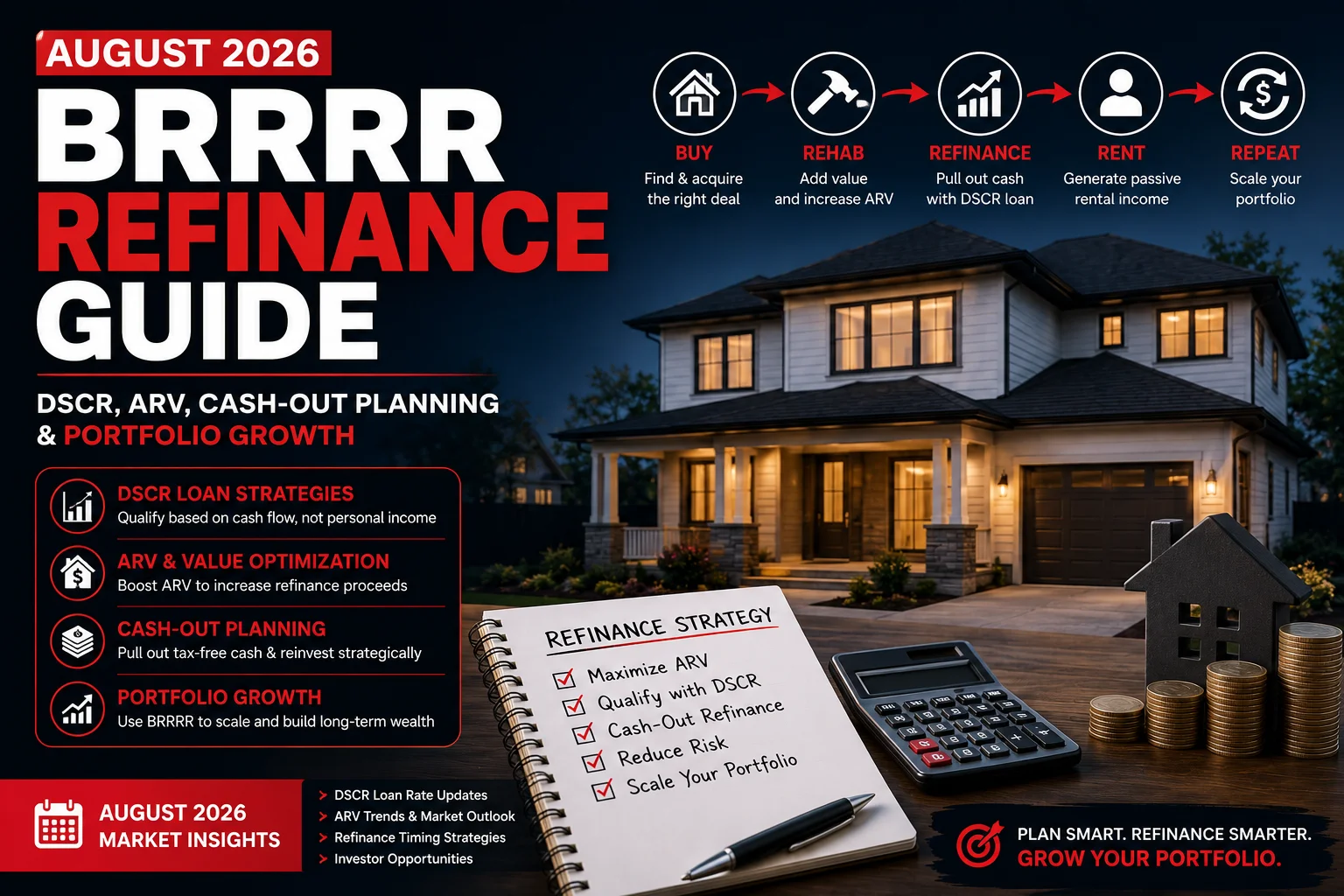
August 2026 BRRRR Refinance Guide
The refinance is the stage that determines whether a BRRRR project becomes a repeatable capital engine or a property that absorbs more cash than expected. For experienced investors scaling a portfolio, the goal is not simply to qualify for permanent financing. It is to choose a refinance structure that balances capital recovery, monthly cash flow, debt risk, and the ability to fund future acquisitions.
This August 2026 guide focuses on the variables that matter most when moving a renovated rental from short-term financing into longer-term debt: after-repair value (ARV), loan-to-value (LTV), debt service coverage ratio (DSCR), stabilized rent, reserves, seasoning, appraisal risk, and cash-out planning.
Quick Answer: How Does a BRRRR Refinance Work?
After an investor buys, renovates, and rents a property, the short-term acquisition or rehab loan may be replaced with longer-term investment-property financing. The new loan amount is determined by the lender’s underwriting rules, which may include appraised value, LTV limits, rental income, DSCR, borrower profile, reserves, property eligibility, and ownership history.
1. ARV Sets the Ceiling—But It Is Not the Whole Refinance
After-repair value is central to BRRRR because it estimates what the renovated property is worth. But an appraisal alone does not guarantee a specific cash-out amount. The lender may cap leverage, apply program rules, require seasoning, or limit the loan based on rental cash flow.
Experienced investors should therefore avoid treating projected ARV as refinance proceeds. A better model uses several values—for example, expected ARV, a modest downside case, and a more severe appraisal case—and then tests each against the intended LTV and DSCR constraints.
2. Understand the Relationship Between LTV and Cash-Out
LTV compares the loan balance with the property’s value. If a property appraises at $400,000 and a program permits a $300,000 loan, the resulting LTV is 75%. But the investor does not necessarily receive $300,000 in cash. Existing debt, closing costs, escrows, prepaid items, and other required payoffs reduce net proceeds.
For BRRRR planning, model gross loan proceeds and net cash returned separately. Net proceeds are the more useful number when deciding how much capital will actually be available for the next acquisition.
3. DSCR Can Become the Binding Constraint
Debt service coverage ratio measures a property’s ability to support its debt payment using rental income under the lender’s methodology. A simplified expression is rental income divided by qualifying housing debt or debt service, although exact calculations vary by program.
If the proposed loan creates a payment that is too high relative to qualifying rent, the DSCR requirement may limit proceeds even when the property has substantial equity. This is why experienced investors should underwrite rent and financing costs together rather than relying on value alone.
4. Use a Refinance Waterfall Before the Rehab Is Finished
A refinance waterfall shows where the new loan proceeds go. Start with the estimated permanent loan amount, then subtract the bridge payoff, accrued interest if applicable, closing costs, escrows, and any other required items. The remainder is the estimated cash returned to the investor.
- Estimated stabilized value
- Maximum loan based on LTV
- Maximum loan supported by DSCR or program rules
- Expected new loan amount
- Short-term debt payoff
- Estimated refinance costs and required escrows
- Net cash returned
- Original cash still remaining in the property
5. Stress-Test the Refinance
A scaling portfolio should not depend on one perfect appraisal or one perfect rent assumption. Model what happens if value is 5% to 10% below target, market rent is lower, the property takes longer to lease, or the refinance closes later than planned. Then measure the effect on cash returned, debt service, reserves, and the timing of the next acquisition.
This exercise can reveal whether a deal is truly repeatable. If a small valuation change forces a major capital injection, the acquisition may have been too dependent on maximum leverage.
6. Choose Between Maximum Cash-Out and Stronger Cash Flow
Experienced investors often face a tradeoff: extract more equity for the next deal or leave more equity in the property to reduce debt service. The right choice depends on the return available on redeployed capital, the portfolio’s liquidity, rate and loan terms, concentration risk, and the property’s stabilized cash flow.
A lower loan amount may produce stronger monthly coverage and reduce refinance sensitivity. A higher loan amount may accelerate portfolio expansion. The decision should be made at the portfolio level rather than based solely on the desire to recover all original cash.
7. Prepare a Lender-Ready Refinance File
Documentation speed can influence capital velocity. Keep the property file organized while the rehab is in progress so the refinance package can be assembled quickly. Depending on the program, useful documentation may include the purchase closing statement, current loan statement, lease, insurance, entity documents, bank statements, renovation records, invoices, permits when applicable, and evidence of property condition.
Requirements vary, and lenders may request additional documentation. The practical goal is to eliminate avoidable delays caused by missing records.
8. Portfolio-Level BRRRR Refinance Strategy
When several BRRRR properties are moving through the pipeline, refinance sequencing matters. Investors can track expected completion dates, lease-up dates, refinance eligibility, debt maturities, extension deadlines, and projected cash releases on one portfolio calendar. This makes it easier to see whether new acquisitions are relying on refinance proceeds that may arrive later than expected.
Portfolio operators should also watch total leverage and reserve needs after each refinance. Recycling capital is valuable, but repeatedly extracting equity without maintaining adequate property-level cash flow and portfolio liquidity can make growth fragile.
August 2026 Refinance Questions to Ask a Lender
- How is DSCR calculated for this program?
- What LTV or cash-out limits apply to this property type?
- Are there ownership-seasoning requirements?
- How will market rent versus lease rent be treated?
- What reserve requirements apply?
- Are there prepayment penalties or other exit costs?
- How is the appraisal ordered and reviewed?
- What entity, experience, credit, or liquidity requirements apply?
- What is the expected closing timeline after the file is complete?
Frequently Asked Questions
What is ARV in a BRRRR deal?
ARV means after-repair value: the estimated market value of a property after the planned renovations are completed. It is commonly used when evaluating rehab economics and potential refinance leverage.
What is DSCR in BRRRR refinancing?
DSCR, or debt service coverage ratio, is a measure lenders may use to evaluate whether qualifying rental income supports the property’s debt obligation. Calculation methods and minimum requirements vary by lender.
Can an investor recover all cash invested through a BRRRR refinance?
It is possible in some deals, but it is not guaranteed. Net cash returned depends on value, leverage, debt payoff, lender requirements, closing costs, rent, DSCR, and other underwriting factors.
What happens if the BRRRR appraisal is lower than expected?
A lower appraisal can reduce the maximum loan amount and cash returned. Investors can prepare by using conservative ARV assumptions, maintaining liquidity, and planning alternative refinance or exit scenarios.
Is maximum cash-out always best for portfolio growth?
No. More cash-out can provide capital for new acquisitions, but it also increases debt and may reduce monthly cash flow. Experienced investors should compare the expected return on redeployed capital with the added financing risk.
Final Takeaway
The refinance is where BRRRR strategy becomes portfolio strategy. For August 2026 deals, experienced investors should model ARV, LTV, DSCR, debt payoff, net proceeds, reserves, and downside scenarios before the acquisition loan closes. A well-planned refinance can release capital for the next opportunity while preserving sustainable cash flow and liquidity.
Investment Property Loan Exchange can help investors evaluate financing options across the BRRRR cycle. Because lender guidelines and market terms change, verify current program requirements before relying on any specific leverage, DSCR, seasoning, or pricing assumption
 Previous Post
 Next Post


